
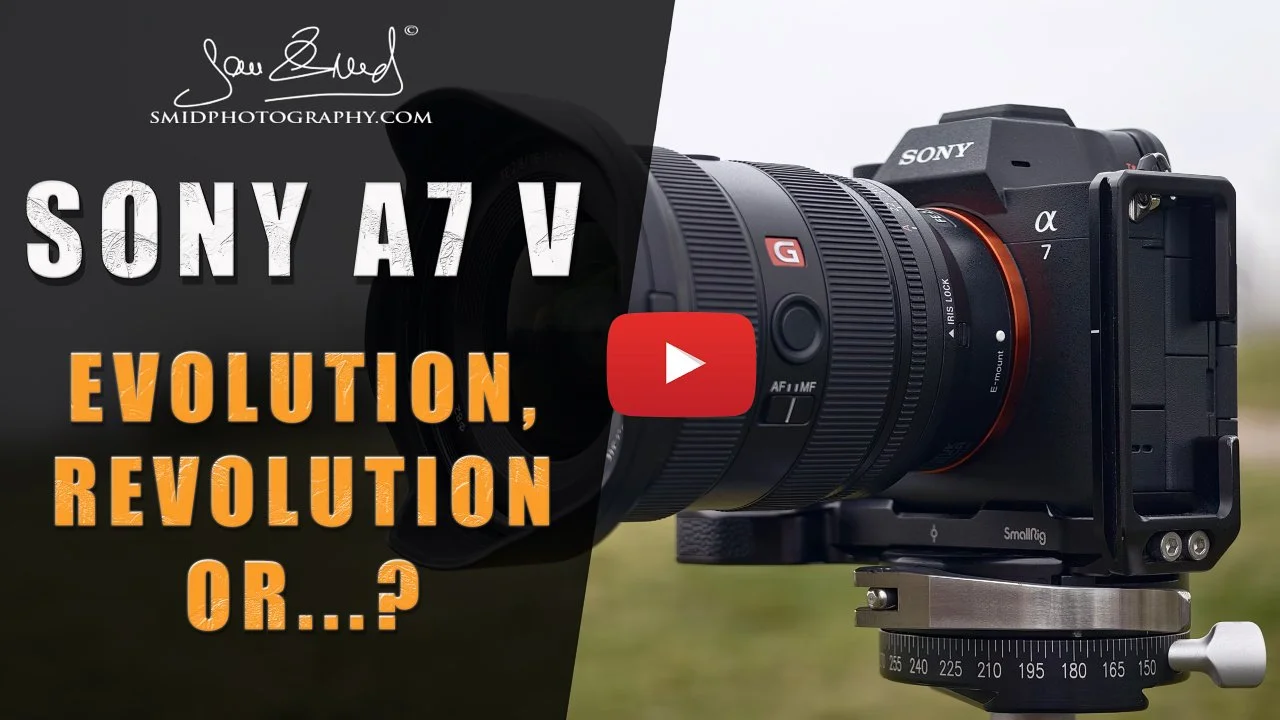
Sony A7 V Landscape Review: Evolution, Revolution or...?
The Sony A7 V is one of the most talked-about cameras Sony has released in years — not because it’s radical on paper, but because it replaces a body that became the default choice for thousands of serious photographers.
So the real question isn’t specs.
It’s this: does the Sony A7 V actually improve real-world landscape photography — or is it just a safe refresh?
I tested the camera the only way that matters: outside, in real conditions, not in a studio.
🎥 Watch the Full Field Review:
🔥 Why the Sony A7 V matters if you shoot landscapes
On my photo expeditions — from Lofoten and Iceland to Alaska, Namibia, and the Outer Hebrides — the Sony A7 IV was everywhere.
That’s exactly why the A7 V matters.
If Sony got this update wrong, people would notice immediately.
Familiar body, smart decisions
At first glance, the A7 V feels very familiar — and that’s intentional.
almost identical size and weight to the A7 IV
same 33-megapixel resolution (a very smart choice)
slightly improved grip and control layout
For landscape photography, 33 MP remains the sweet spot: enough detail, strong dynamic range, manageable files, fast workflow. No spec-race nonsense.
The upgrade you feel in the field
The most important change is the new semi-stacked sensor, which brings noticeably more usable dynamic range. Sony officially talks about 16 stops, but what really matters is how flexible the RAW files feel when working with contrast, highlights, and shadows.
Add to that:
a fully articulating rear screen that finally works in every shooting position
a protective sensor curtain when powering off
better battery endurance with USB-C charging in the field
Suddenly, this “basic” A7 body feels unusually complete.
⚡The one feature that changes everything for landscape shooters
This is the reason the A7 V surprised me.
For years, Sony’s exposure bracketing workflow was unnecessarily clumsy. With the A7 V, that limitation is finally gone.
You now get:
continuous exposure bracketing
live exposure simulation
zebras
one single shutter press
No mode switching. No guesswork. No cable release.
For landscape photographers, this alone makes the A7 V a serious upgrade.
🎥 Quick note for video shooters
Yes — overheating is finally under control.
I tested the A7 V under the same conditions that made the A7 IV struggle, and the camera just kept recording. No warnings, no tricks. Plus modern tools like S-Cinetone, LUT preview, Auto-Framing, 4K 60p and 4K 120p.
Evolution or revolution?
For me, the Sony A7 V is evolution — with one genuinely revolutionary fix.
It’s the first A7 body that feels truly finished for landscape photography. No missing essentials. No “almost”.
👉 For full field tests, real examples, and my honest verdict, watch the complete video review on YouTube below.
Want to go deeper than reviews?
If you want to understand how to actually use tools like this in the field — exposure, bracketing, composition, decision-making — I also offer 1-on-1 photography mentoring focused on real shooting, not theory.
And if you want to test gear like this where it really counts:
See you in the field — or on YouTube.
About the Author
Jan Smid is a Master QEP, Zeiss Ambassador and expedition leader working across a wide range of photographic environments — from demanding locations such as Namibia, Alaska, Iceland or Lofoten, to more relaxed and accessible destinations including Madeira and the Wachau. He is the recipient of over 300 awards from international photography competitions and runs an independent YouTube channel focused on real field photography, composition and long-term photographic growth.
Frequently Asked Questions about the Sony A7 V
-
Yes — especially if you rely on exposure bracketing, shoot in high-contrast scenes, or want a faster, cleaner workflow in the field. The improved bracketing behavior alone makes a real difference.
-
The ability to use continuous exposure bracketing with live exposure simulation and zebras. It allows precise highlight control with a single shutter press, which dramatically speeds up field work.
-
Yes. The new semi-stacked sensor offers noticeably more usable dynamic range, giving more flexibility when recovering highlights and shadows in RAW files.
-
Absolutely. 33 MP is a near-perfect balance between resolution, dynamic range, noise performance, file size, and workflow speed — especially for panoramas and large prints.
-
In real-world testing, overheating is no longer a practical issue. The camera handles long recordings far more reliably than the A7 IV under the same conditions.
-
Yes. Features like the built-in bulb timer with live countdown, improved sensor performance, and better power management make it very well suited for night photography and ND filter work.
-
Definitely. Its combination of image quality, reliable power options, weather-friendly design details, and versatile screen makes it ideal for demanding outdoor and expedition use.
-
The full hands-on field review is available in the linked YouTube video, filmed and tested in real shooting conditions, not a studio.