
2026 Best Landscape Lenses: Nikon, Sony, Canon & Workshops
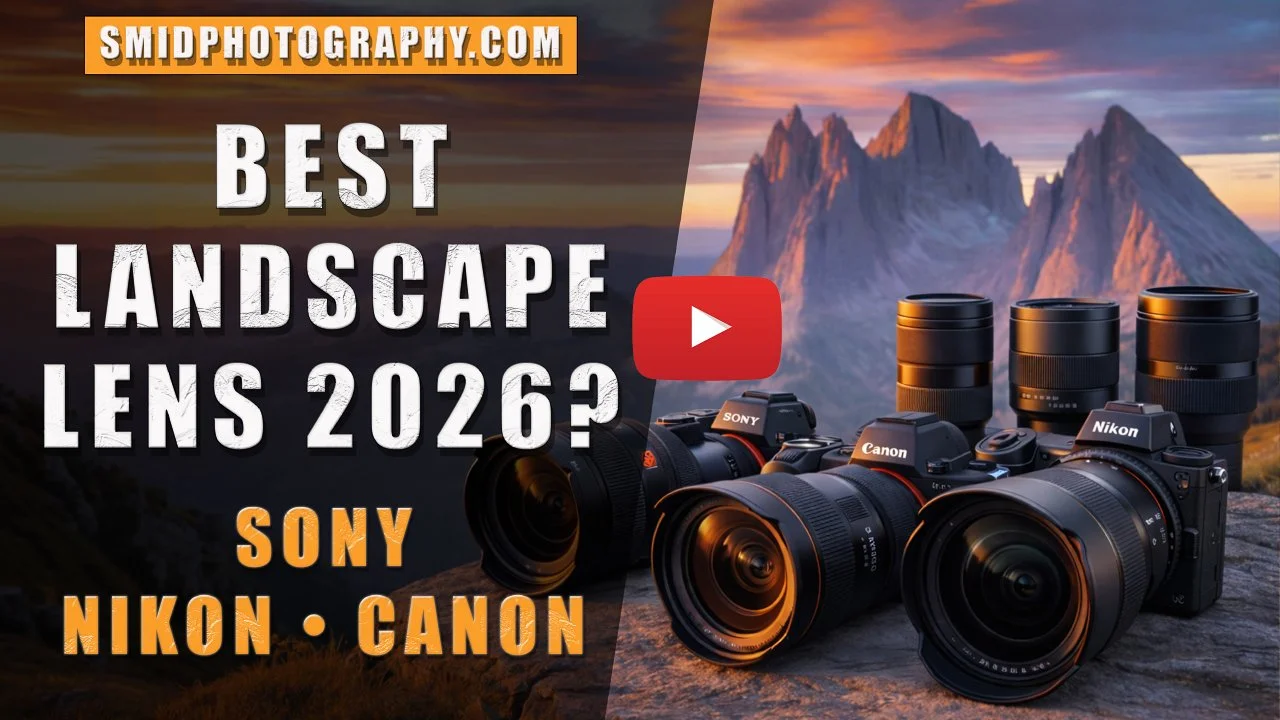
One zoom. One prime. No excuses. Choosing the right glass for landscape photography isn’t about charts or polite recommendations—it’s about technical dominance in the field.
Hey guys, it’s Jan. I brought a camera, a tripod, and the slightly dangerous idea that today we’re going to choose the best landscape photography setup for Canon, Nikon, and Sony in 2026. We aren’t talking about "safe" choices. We are looking for the gear that survives the Arctic wind, handles the salt spray, and captures the pinpoint stars of the Aurora Borealis without compromise.
All these lenses were tested in real conditions. Repeatedly. Across different seasons and different light. If you want to experience this gear in action instead of just watching a screen, join our Photo Expeditions. We go deep into lens choice, filters, and real composition on location.
The Rules of the Evaluation
To keep this analysis professional, I’ve set strict criteria. If a lens doesn't meet these, it isn't a serious landscape tool:
Full-frame mirrorless only. No compromises on sensor size.
Wider than 24mm. 24mm is not universal enough for serious wide landscape work or Aurora.
Speed is key. Nothing slower than f/4. For serious night work, light is non-negotiable.
Filter Practicality. No extreme bulbous front elements. I want to stack a polarizer and ND filter without a satellite dish setup.
🎥 Watch the Full Field Review:
Canon RF: The L-Series Dominance
For Canon RF full-frame, we are seriously considering the 15–35mm f/2.8 L, the 14–35mm f/4 L, and for primes, the 20mm f/1.4 L.The 15–35mm 2.8 feels like Canon’s answer for a universal Photo Tour lens. It's dramatic at 15mm and sharp at 35mm. But is the weight worth it? Or does the 20mm f/1.4 L offer the technical dominance you need for the Milky Way? The answer depends on your workflow, but in the video, I reveal which one is the absolute king of the RF mount for 2026.
Nikon Z: The S-Line vs. The Disruptor
The Nikon Z system carries a heavy legacy. The 14–24mm f/2.8 S is a masterpiece, but its 24mm long end is a limitation in the mirrorless era. We also look at the 14–30mm f/4 S and the budget-friendly 17–28mm f/2.8.However, the real winner for Nikon landscape photographers in 2026 might be a third-party lens. There is a specific challenger that offers better corner performance and a more practical range than the native budget options. I'll show you exactly why in the field test.
Sony E-Mount: The Reference Point
The Sony ecosystem is the most mature. From the 16–35mm f/2.8 GM II benchmark to the ultra-sharp 16mm f/1.8 G, the choice is tough. Does the compact 16–25mm 2.8 G hold up under the pressure of a high-resolution sensor, or do you need the flagship GM glass to exploit every pixel?
WATCH THE VERDICT: Best Landscape Lenses 2026
I’ve tested these lenses on Atlantic cliffs and in Arctic winds. In the video below, I reveal the absolute winners for each brand. One of these choices will likely surprise you—especially the winner for Nikon.
Master Your Gear Beyond the Maps
Gear is only one part. Using it under pressure is another. Our Photo Workshops and Photo Expeditions to Lofoten, Iceland, Namibia, or Alaska are designed to take your technical skills to the master level. We don't just show you the way; we provide Personalized Guidance and Masterclass Field Training.
1:2 Instructor Ratio: The strongest argument for your technical progress.
Scout-Built Itineraries: Locations not found in guidebooks.
Panoramic Workflows: We teach high-end techniques that dominate the competition.
Jan Smid, Master QEP • ZEISS Ambassador • 300+ International Awards
See you in the field — or on YouTube.
About the Author
Jan Smid is a Master QEP, Zeiss Ambassador and expedition leader working across a wide range of photographic environments — from demanding locations such as Namibia, Alaska, Icelandor Lofoten, to more relaxed and accessible destinations including Madeiraand the Wachau. He is the recipient of over 300 awards from international photography competitions and runs an independent YouTube channel focused on real field photography, composition and long-term photographic growth.
Frequently Asked Questions about the Best Landscape Lenses 2026
-
In 2026, the 16–35mm range remains the gold standard. It allows you to capture dramatic foregrounds at the wide end while giving you enough reach at 35mm to frame more intimate scenes without changing lenses in harsh environments like the Arctic or the desert. During our expeditions, we find that this range covers about 80% of most photographers' needs.
-
Optically, yes. A prime lens like the 20mm f/1.8 or f/1.4 offers superior coma control and edge-to-edge sharpness that even the best zooms can't fully match. More importantly, the extra light allows for lower ISO, resulting in cleaner files for large-format printing. This is a key focus of our masterclass field sessions.
-
Efficiency in the field is everything. Lenses with extreme bulbous elements require massive, expensive filter holders that are difficult to manage in wind or spray. We prioritize lenses that support screw-in or slim magnetic filter systems, allowing you to react quickly when the light hits its peak.
-
It matters the moment you print large or shoot stars. Soft corners can ruin the immersion of a wide-angle landscape. We analyze these technical nuances during our 1-to-1 mentoring sessions to ensure your gear isn't the bottleneck for your creative vision.
-
If you have to commit to one, pack a high-quality 16–35mm f/2.8. It’s the most versatile tool for the diverse conditions we encounter—from the blue hour on Madeira to the dancing Aurora in Norway. If you're unsure about your current kit, we provide a full gear consultation before every trip.